26/27 Punt Steals Guides
The Punt Steals Strategy
This is another punting guide that is worth a read, even if you have another strategy in mind. Not because it’s a strategy a large chunk of your league is going to deploy, like punt FG% is, but because this is a strategy that works well not only as a primary strategy but as a mid-draft pivot. Having a backup strategy you can pivot to is very important, as you can never predict with 100 percent accuracy how a draft is going to go. Even if you’ve been drafting with the same group of friends for a decade, you are still going to get some surprises early, and sometimes all it takes to destroy Plan A and Plan B is an unfortunately timed reach from an opponent. If you have a strong pivot strategy in place, then you’ll be fine. If you don’t, then you’re going to be on tilt two or three rounds in, and that never ends well. Punting steals works great as a mid-round pivot because you don’t have to commit to the strategy early on. You are never going to come out of the fourth round drawing dead in steals. It’s not the easiest category to find during the second half of the draft, but there isn’t any combination of early-round players that prevents you from getting back to at least average in the category. It also works as a mid-season pivot. A lot of high-SPG players do not produce well-rounded lines, and dropping or trading them mid-season can lead to significant gains elsewhere. I saved my season in one of my main leagues a couple of years ago by doing just that. My punt assists team was struggling early on, and I realized I needed to improve almost across the board. I took a good look at my team and figured out that some of my high-SPG players were making it tough for me to win the categories I needed to win consistently. Once I swapped strategies and swapped out those players, the team started winning consistently and eventually rolled through the playoffs. Punting steals isn’t the sexiest strategy in the world, but it will lead to championship-level teams when done right.
Year-To-Year Category Variance
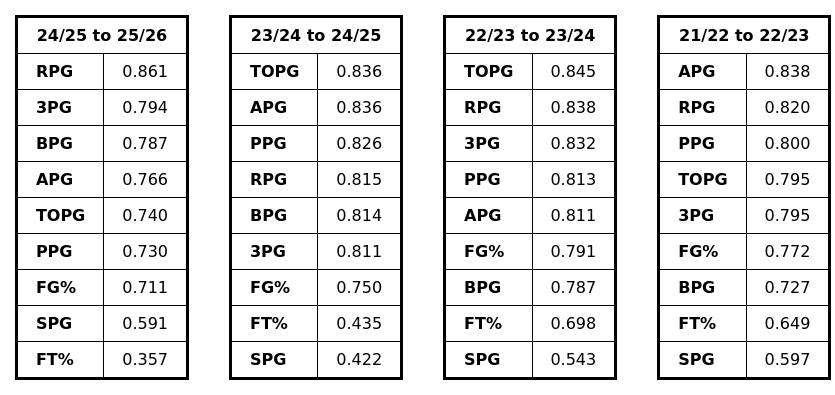
The number at or near the bottom of each chart is why punting steals makes sense. Before I expand further, let me tell you what these numbers are and how I got them. When projecting individual player performance, some categories are easier to predict than others. To figure out which categories fall into the easier-to-predict basket and which categories come with a little more variance, I analyzed player performance in each category for each of the past four seasons. I looked at how the top-150 players in nine-category leagues during the 2021-2022 season fared in each category during the 2022-2023 season, how the top-150 players during the 2022-2023 season fared in each category during the 2023-2024 season, how the top-150 players during the 2023-2024 season fared in each category during the 2024-2025 season, and how the top-150 players during the 2024-2025 season fared in each category during the 2025-2026 season. I calculated the R2 for each category, and the above chart shows us the results. The R2 number tells us how useful a player’s prior-year average in a category is going to be when predicting this year’s average in that same category. For example, these numbers tell us that prior-year APG is a better predictor of APG in the upcoming year than prior-year 3PG is of 3PG for the upcoming year. It tells us that Nikola Jokic‘s prior-year rebounding is a more useful data point when projecting his rebounds for this coming season than his 2025-2026 steal rate is for projecting his steal rate in 2026-2027.
If you look across all four charts, you’ll notice that steals is at the bottom nearly every time, with the lone exception being last season. What this tells us is that steals is much harder to predict than the other categories. Only FT% comes somewhat close to being as difficult to project. We may think we have a strong steals team coming out of the draft, but we really won’t know until the season starts. Players underperform (and overperform) in steals much more often than they do in categories like assists or rebounds. Because of this, any team that comes out of the draft needing to win steals consistently is going to carry more risk than any team that is not dependent on winning the category. In short, punt steals is a high-floor strategy when implemented properly.
Correlation Analysis And The Build’s Natural Strengths And Weaknesses

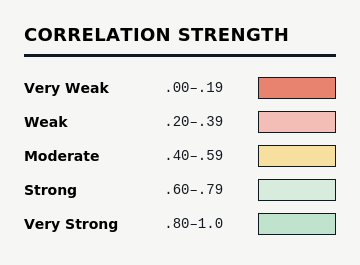
Steals is a fairly unique category due to how weak its relationships with the other eight categories are. Every other category has a moderate-to-strong relationship with multiple categories. For example, FG% has a strong positive relationship with rebounds and blocks. That means players who excel in FG% usually excel in rebounds and blocks, and players who struggle in those two categories tend to be drags on the FG% category as well. Last season, steals did not have even a moderately positive relationship with any category, although in the past, its relationship with assists has landed in that range.
The weak correlation between steals and almost all the other categories means that when we punt steals, we are not hurting our ability to compete in any other category, with assists being the one potential exception. Unfortunately, this also means that punt steals doesn’t come with as many natural advantages as other builds. Punting steals doesn’t almost automatically lock in categories like punt FG% does with threes and FT% or punt FT% does with rebounds and blocks. The lack of natural advantages would be more of a problem if it weren’t for one advantage that no other build except punt assists can claim. That is the ability to finish the draft in an above-average or even dominant spot in both FG% and FT%. Because of steals’ weak relationship with both FG% and FT%, we can easily build a team that excels in both areas. That is not the case with a build like punt blocks. When you pass on blocks, you are usually passing on some of the elite sources of FG% impact. The same goes for punting threes. Passing on high-volume three-point shooters usually leads to issues with FT%. This build’s advantage in the percentages is notable because the percentages are the best categories to be strong in. Being strong in the percentages gives your team a higher floor and a higher ceiling. If your team is near the top of the league in both percentages, your team is less likely to struggle during weeks when the schedule is unfriendly. You will likely lose some counting categories you normally win during weeks when the schedule works against you, but if you are strong in the percentages, you’re probably not going to get blown out. Being strong in both categories also gives your team a higher ceiling because it makes running up the score during weeks when the schedule is in your favor more likely. A team that is strong in counting stats but weak in the percentages won’t benefit as much from a friendly schedule since having more games won’t boost its percentages. Being strong in the percentages during a week when you have a games advantage is more likely to lead to a blowout win because you’ll be winning the percentages while your slightly weaker counting stats will be receiving a bump from the friendly schedule.
Players missing more and more games strengthens the argument for chasing the percentages over the counting categories. Unless you get extremely lucky, you are going to get hit hard by injuries at some point this season. If you are all in on the counting categories, your floor during the weeks where you have a handful of players out with injuries is going to be very low. During those weeks, you’ll lose the counting categories and the percentages. On the other hand, if you build your team around the percentages, you will have a much better shot at picking up three or four categories and surviving the week. Focusing on the percentages instead of the counting categories ended up being the difference between a championship and a trip to the consolation bracket in one of my main leagues a few seasons ago. Due to an insanely unlucky stretch of injuries, I started the year 2-11-1. Normally, a start that poor would doom a team, but since my team was excellent in both percentages, a lot of those losses ended up being of the 4-5 variety. Avoiding getting blown out allowed me to stay within striking distance of the final playoff spot, and a 5-0 run to end the season was enough to get my now-healthy team into the playoffs, where it proceeded to annihilate the competition. If I ignored the percentages, like some other sites suggest, all my injuries would have led to the most embarrassing fantasy performance of my career. Instead, because I focused on the percentages, I have a fun story to tell my fellow fantasy nerds and an extra trophy in the trophy case.
As mentioned earlier, assists is a category that can be a problem for punt steals teams. However, it is a very fixable problem. If we are smart with our point guard targets, we can end up where we need to be in dimes. Some lead guards lose a ton of value when steals are ignored, but not all of them. We also don’t need to be deathly afraid of taking high-steal players either. As is the case with other builds, we don’t want to be taking too many players who have a lot of value tied up in the punted category, but one or two is fine. We just have to make sure we get a good price on those players. If a player’s projected value without steals is similar to his ADP, that’s a player we want to target. Check out last year’s punt steals rankings and this year’s punt steals projections before deciding on which point guards to target. If the projections are in line with the point guard’s ADP, then targeting that player is going to make a lot of sense. If the high-steals/high-assists player ends up ranked three rounds lower than their price on draft day once steals are ignored, then you should take that player off your draft board.
Also, don’t worry if you can’t find enough assists by the end of the draft. Just try to be somewhat close to average in the category. Your goal on draft day is not to build a perfect team. It is to put together a solid core that is only a couple of smart pickups away from dominating. If you come out of your draft one 5.5 APG player away from being in a good spot in dimes, I would consider that a success. You will find that player on the wire eventually.
For access to the full guides, follow these links:
2026-2027 Punt Steals Guide (Yahoo)
2026-2027 Punt Points Guide (ESPN)
For access to all of this year’s punting guides, projections, rankings, tools, pairing guides, sleepers and busts, and much, much more, subscribe here: